Department of Communication
Doctor of Philosophy in Communication: A Distinguished Program
Since the doctoral program began in the late 1950's, over 350 men and women have completed their Ph.D. in Communication at MSU. The alumni hold faculty positions in many leading universities, and as well as research and consultative positions in government and industry. Graduates provide leadership in academic and professional fields in many countries throughout the world. The COM doctoral program features outstanding faculty who are prolific researchers and effective advisors (Meet the Faculty).
Based on a longstanding combination of productive scholars and successfully alumni, our doctoral program ranks at the top nationally in reputation, productivity, and key awards:
NCA Reputation Survey
In the 2004 NCA reputational survey ratings of "effectiveness of PhD program", MSU ranks #1 in health communication, #1 in communication & technology, #2 in mass communication, #4 in interpersonal & small group, and #4 in international & intercultural. Among the subset of comprehensive doctoral programs (at least five specialties), MSU has the top average rating score.ICA Fellows
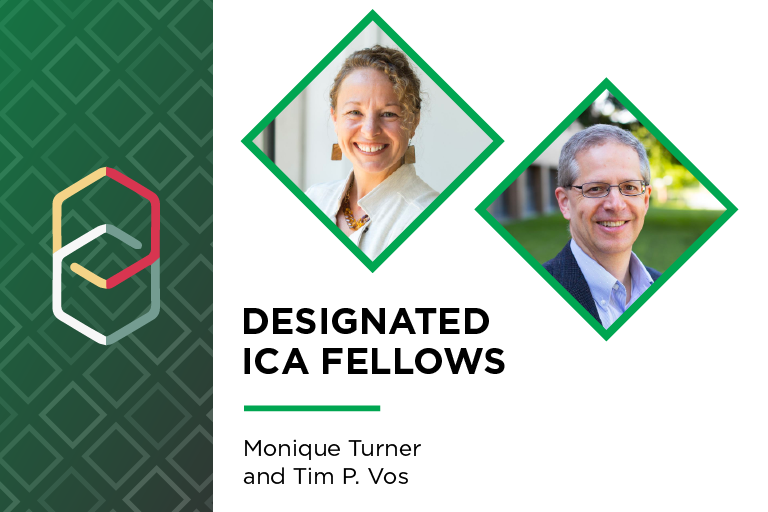
The COM doctoral program has produced more ICA Fellows than any other university (Charles Berger, Michael Burgoon, Joe Cappella, Akiba Cohen, Brenda Dervin, Randy Harrison, Peter Monge, Byron Reeves).Mentor Awards
Current and former COM faculty have won one-third of ICA mentor awards for doctoral advising, more than any other university (G.R. Miller, Brad Greenberg, Frank Boster, Judee Burgoon, Ed Fink, Peter Monge)Core Journal Productivity
COM researchers rank first in latest research productivity study published in the Journal of Communication, which analyzed authorship of articles published between 1999-2004 in eight leading journals sponsored by NCA and ICA. MSU was #1 in publications by current faculty and students, and #1 in publications by doctoral alumni.Productive Researchers
COM placed 11 faculty and doctoral alumni among the top 50 most productive researchers in two dozen communication journals from 1996-2001, according to a study published in Communication Research Reports.Meet the Faculty
View a detailed list of faculty members contributing to the Communication Ph.D program, Meet the Faculty link.The Program
Communication is a social process. It links humans through the creation, transmission, and reception of messages. The doctoral program focuses on the scholarly analysis of these linkages, with an emphasis on the characteristics of the messages and channels through which linkage occurs, along with the antecedents and consequences of message linkages. The Ph.D. program in the Department of Communication is primarily a research degree. Its goal is to prepare the student to be a well-rounded scholar--someone who can conduct behavioral research, and offer informed consultation about communication to others. The program places a strong emphasis on preparing the student to teach in a variety of contexts at the undergraduate and graduate levels.The doctoral program is designed as a three-year period of study, including the dissertation, and is organized around a set of experiences that stimulate an interdependent community of communication scholars. These experiences are intended to maximize creative growth and development, and to provide the student with the skills needed to manage an intellectual community. Thus, the student is intensively involved in coursework, teaching, and research, usually concurrently. Successful performance in all three areas is considered necessary for completion of the degree. There are two basic tasks of a community of communication scholars in which the student must demonstrate competence:
1. Teaching. The entering student receives training in instructional models and teaching methods in communication education. Each student serves as an apprentice in supervised teaching situations, leading to a demonstration of independent competence in teaching.
2. Research. The student is assigned to a task group that explores research questions to which the Department has assigned priority. Each student participates in various phases of on-going research projects. Responsibility for the design and conduct of research is increased as competence develops. Each student must present at least one major report of original research which has been conducted independently.
Admission Procedures
For admission to the doctoral program in communication the application review begins December 1 with later applications considered until at least February 1. Applications will be reviewed only with receipt of all application materials (please click on this link for futher information). Applications are accepted for Fall semseter only.Degree Requirements
Required courswork for the doctoral degree in Communication falls into the following areas:All the following core courses (16 credits)
COM 801: Communication Research I
COM 802: Communication Research II
COM 901: Communication Research Design I
COM 902: Communication Research Design II
(One must earn an average of 3.25 with no two grades below 3.0 in these core courses, or be eligible for elimination from the program.)
Additional Requirements
1. A total of 42 credits of courswork with an additional 24 credits of dissertation hours are arranged so students are broad and deep in two areas.
2. The student must write a preliminary paper or take comprehensive examinations, and present a colloquium (oral presentation) to the department.
3. The student must write a dissertation and successfully defend during a final oral examination.
Doctoral Program Forms
The forms are available online but are NOT interactive. You may print a copy, complete the information and take to your advisor and committee for signatures. The forms CANNOT be sent to your advisor/committee electronically for their signatures.
Doctoral Program Handbook
The handbook for the Ph.D. in Communication is available online. Please click on the link above.
Certificate in College Teaching Option
View the Guidebook for Certificate in College Teaching" (pdf format)
Additional information about the Doctoral program in Communication may be obtained from:
Marge Barkman
Academic Programs
466 Comm Arts Building
East Lansing, MI 48824-1212
Tel: 517.355.3471
Fax: 517.432.1192
E-Mail: barkman@msu.edu
The information enclosed here should be viewed as a general overview of the academic program for this degree. It should not be viewed as the final authority on degree requirements. Make sure to consult your academic advisor to clear your specific program of study.
Application Information
Requirements
Handbook
Doctoral Program Forms
Independent Study Form
Certification in College Teaching
Faculty research interests
Related Sites
CAS Graduate Commons
Overview of Financial Assistance
P.R.E.P. (Planning, Resilience, Engagement, Professionalism)
Traveling Scholar Program
MSU Financial Aide Information
Health and Risk Communication Center
Resource Center for Persons with Disabilities
Requirements
Handbook
Doctoral Program Forms
Independent Study Form
Certification in College Teaching
Faculty research interests
Related Sites
CAS Graduate Commons
Overview of Financial Assistance
P.R.E.P. (Planning, Resilience, Engagement, Professionalism)
Traveling Scholar Program
MSU Financial Aide Information
Health and Risk Communication Center
Resource Center for Persons with Disabilities